After a spinal cord injury (SCI), there is a period that doesn’t get talked about much. The most critical window of medical care has passed, the intensity of early rehabilitation has begun to settle, and the future is still taking shape. For many people, this is when the absence of the life they knew becomes most apparent. Not the dramatic losses, which have their own grief, but the quieter ones. The rhythm of a workday. A professional identity. Somewhere to be and a reason to be there. Work carries more than income—it creates purpose and when it disappears, what fills that space is not always easy to name.
This is where many people with SCI begin to rethink how they might enter the workforce, not because someone introduces the idea, but because the desire to contribute is hard to ignore for long. A grantee partner researching this transition found that people who went through a structured return-to-work program reported that having someone dedicated to helping them think through their options, earlier in their recovery rather than later, made a meaningful difference in how prepared and supported they felt. What happens during that stretch of time matters enormously in shaping someone’s experience.
Another partner has built an entire program around the philosophic idea that re-entering the workforce is often a gradual process. It is something you move toward through smaller acts of capability and contribution. This program allows people living with severe injuries to participate in a vocational program whether that begins with learning to use adaptive technology or taking part in work connected to the community around them. From the outside, these may look like activities; however, for the participants, these can be some of the first moments post-injury when they feel like someone with something to offer.
One participant who was a skilled tradesman before their injury, made 175 handcrafted soaps for a fundraising gala. The work required their hands, their attention, and their care. The soaps were a hit! They were the reason.
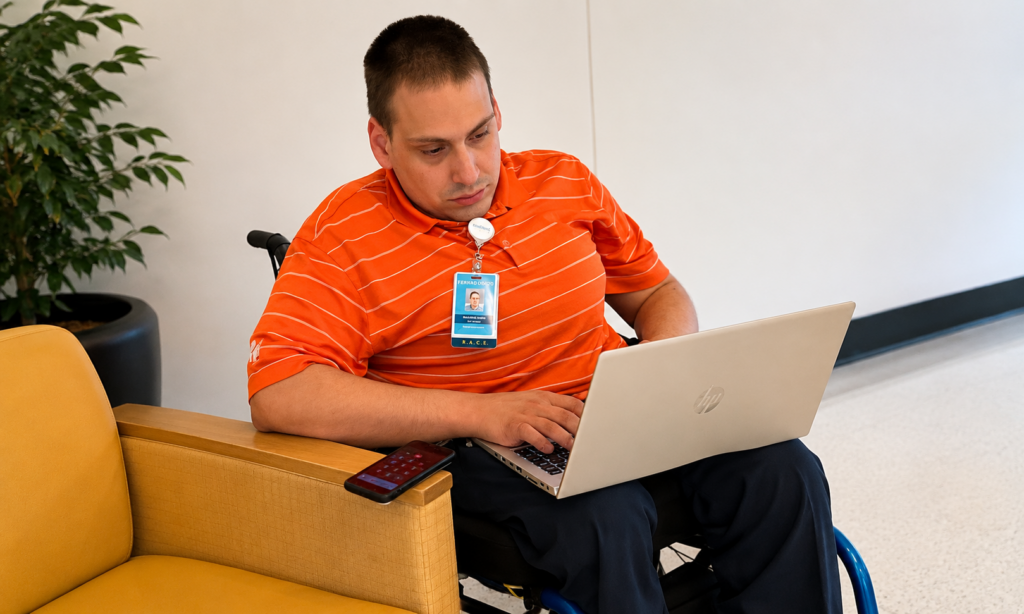
That kind of experience does not appear on a resume, but it belongs to the story of how someone gets ready to work again. The Neilsen Foundation is also proud to support a fellowship program that picks up further along that arc, placing people with SCI into paid, mentored roles in communications, public policy, nonprofit management, and other fields. The program offers coaching for writing, interview preparation, and access to professional networks, but what fellows describe as most valuable is harder to quantify. It is the experience of being in a professional environment where their disability is neither ignored nor centered. It allows individuals the opportunity to navigate the workplace as a person with SCI and is simply part of the conversation. Fellows leave the program better prepared to ask for accommodations, to talk about their experience with employers, and to understand that what they have been through is not a liability to manage but a perspective they carry.
But returning to work after SCI involves far more than getting through the hiring process. Transportation remains one of the most persistent barriers to sustained employment for people with SCI, surfacing even after training and placement are complete. For some, it is the difference between holding a job and losing one.
What the most effective programs understand is that returning to work after SCI is not a single event but a long sequence of them, and that support has to be present across the whole of it. The goal is not just placement—it is the kind of participation that holds, that gives someone not only an income but a reason to get up, somewhere to be, and people who expect them there. Finding the way back to that is not a small thing. We are proud to support the researchers, clinicians, and community organizations working to support the many parts of returning to work that go far beyond what appears on a resume.