
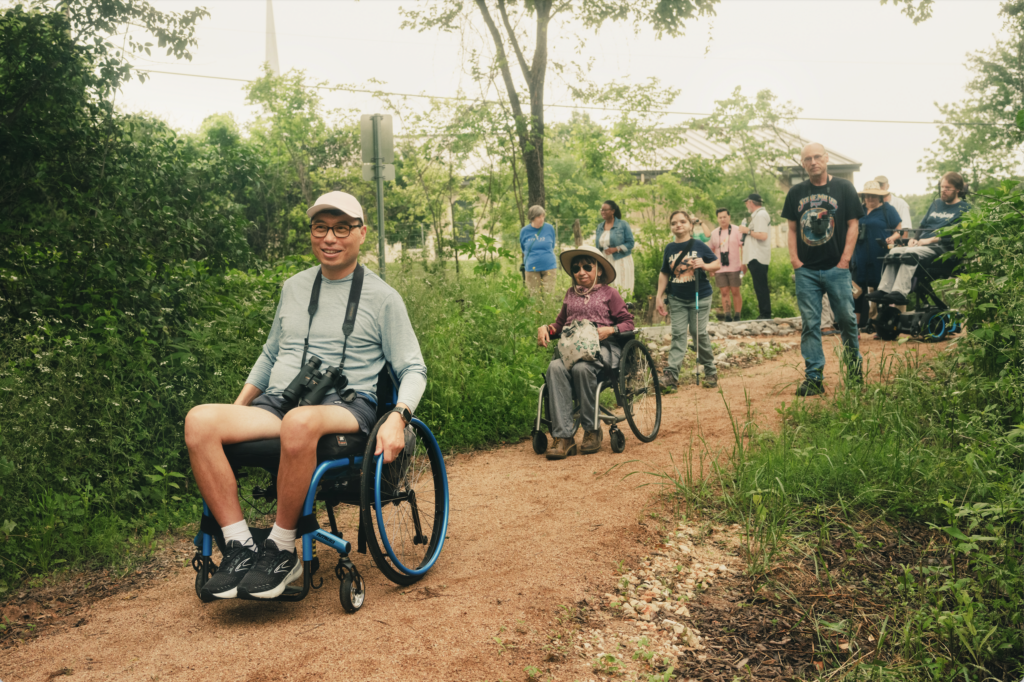
As spring arrives, people begin spending more time outdoors, whether that means tending to a garden, spending time on a trail, or simply gathering with others. For individuals living with spinal cord injury (SCI), those experiences are no different in principle, though they may look different in practice depending on the environment.
Across the world of SCI, organizations supported by the Craig H. Neilsen Foundation are creating more opportunities for people to spend time outside. Social connection influences well-being and through increased accessibility, community-based programming, as well as many rehabilitation environments, sharing time outdoors can have a significant impact on daily living.
Community programs reconnecting people with nature
For one grantee partner, the starting point was a garden. Their program invites individuals living with SCI to participate in small horticultural therapy sessions where participants grow vegetables, herbs, and flowers together as a group.
The program is intentionally structured to support an environment of inclusion through both participation, and connection:
- Small group sessions create space for conversation and shared learning
- Participants return regularly, allowing them to observe how the garden changes week by week as plants develop throughout the season
- Activities are adapted so people with different levels of mobility can take part comfortably
Participants often describe the experience as both relaxing and engaging. The program has organized more than 100 gardening sessions and events, creating regular opportunities for people with SCI to spend time outdoors and connect with others in their community.
Along California’s coastline, another grantee partner uses adaptive track systems that convert manual wheelchairs into all-terrain devices. With this equipment, individuals with SCI can explore beaches and coastal trails alongside volunteer naturalists and educators.
Collectively, these programs highlight how outdoor spaces can become welcoming environments when participation and access is thoughtfully designed.
Outdoor spaces in rehabilitation
Creating outdoor opportunities is also appearing more often in rehabilitation settings.
One grantee partner focused on improving access to a hospital’s garden for use during rehabilitation. The grant funded ceiling lift equipment on the SCI unit, making it easier for patients to transfer out of bed and participate in garden activities earlier in their recovery.
With this type of equipment available, patients began requesting frequent trips to the garden and found a relaxing way to spend time outside with family and friends. The space became another setting where patients could practice independence and learn important new life skills while continuing their rehabilitation.
Research exploring connection and well-being
Researchers are also examining how social environments influence health and quality of life after spinal cord injury. One study supported by the Neilsen Foundation explored social isolation and loneliness. Researchers surveyed 100s of individuals with SCI and mapped the structure of their social networks to better understand how relationships influence well-being.
The findings revealed that social networks were often small. On average, participants reported they had fewer than four people they could turn to for important conversations, and nearly one-third of participants reported high levels of loneliness. At the same time, individuals who interacted more frequently with their social networks and who had a wider range of connections reported lower loneliness and higher life satisfaction. This highlights how environments with community spaces create the opportunity for these important connections to develop naturally.
Looking ahead
These initiatives show how outdoor environments can support everyday life after spinal cord injury. Each program approaches the idea differently, but the goal is similar. They make it easier for people with SCI to spend time outside in ways that feel meaningful to them. Organizations continue developing these approaches while researchers study how connection and everyday environments influence well-being. This work is helping create more opportunities for individuals with SCI to stay engaged with their communities and the activities they enjoy.